Watch a toddler carefully line up blocks into a perfectly symmetrical row. Watch a five-year-old trace the edge of a window with their finger, following the rectangle's corner with quiet precision. They are not doing nothing. They are doing geometry.
Dr. Maria Montessori understood something that conventional education is still catching up to: geometric understanding is not an abstract school subject that needs to be imported into a child's mind from the outside. It is already there. Children encounter geometry every day in the angles of a chair, the hexagons of a honeycomb, the spiral of a shell. Our job is not to teach it. It is to help them see what they are already sensing.
The evidence is cross-cultural
A striking study of the Munduruku people, an indigenous group in the Amazon whose language contains very few spatial or geometric terms, found that both adults and children demonstrated an intuitive grasp of basic geometric ideas without any formal instruction. This wasn't learned. It was already present.
What this tells us is that geometry is not a curriculum invention. It is part of how human beings perceive and navigate the world. A Montessori classroom is designed to build on that foundation not to create it from scratch.
How Montessori introduces geometry: hands first
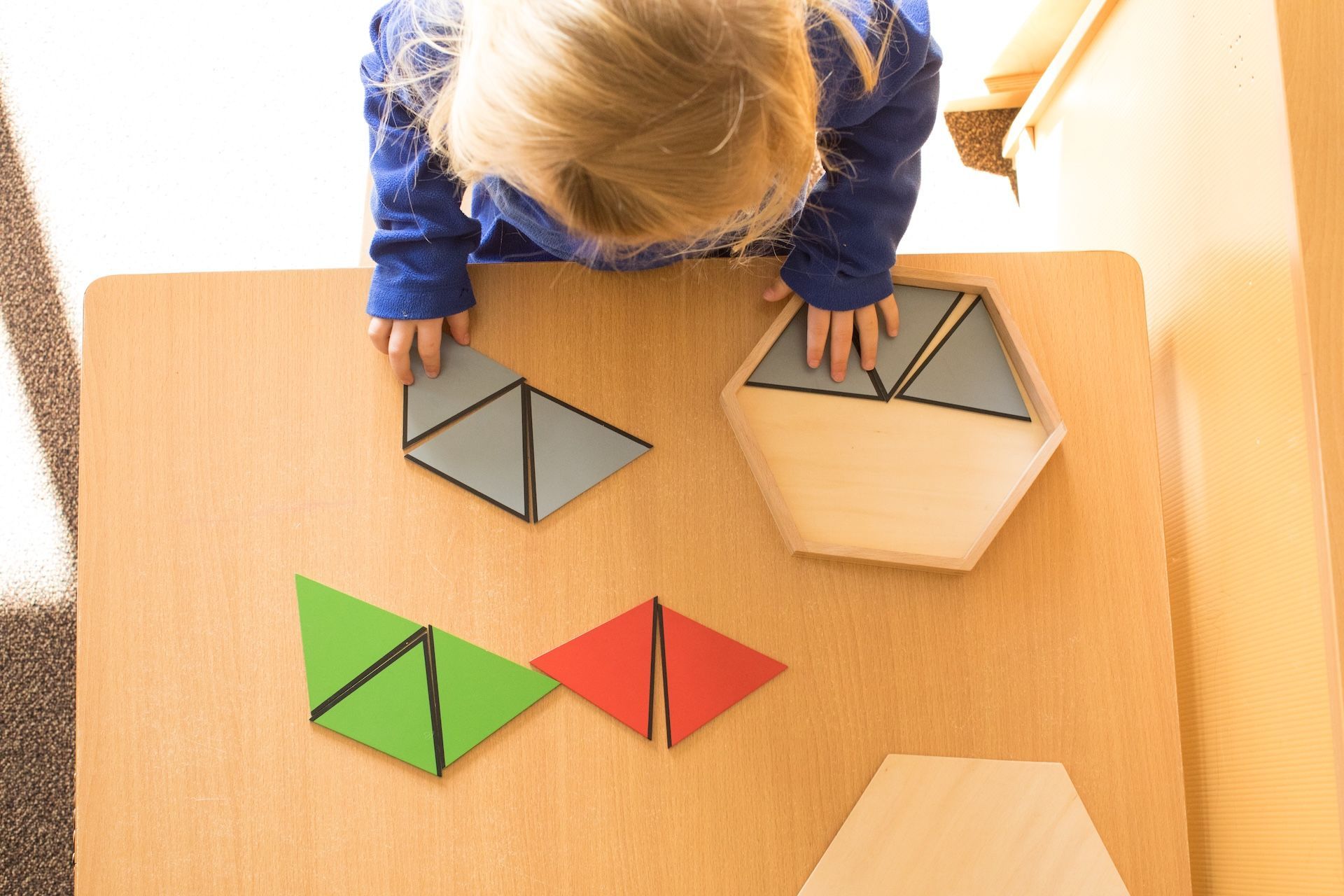
In the early childhood years what we call the Casa, for children aged three to six children encounter geometry entirely through their hands. The Geometric Cabinet, the Constructive Triangles, the Metal Insets: these materials give children a felt, embodied understanding of shape, form, symmetry, and dimension long before they encounter a single word of mathematical vocabulary.
A child who has spent time physically holding a triangle, feeling its vertices, tracing its edges, and discovering that two right triangles make a square, knows something about triangles that a child who has memorized the definition does not. The knowledge lives in the hands, in the body, in the memory of doing and it is far more durable.
The formula comes after the discovery, not before it. That sequencing is everything.
When children are ready for reasons, not just names
In the elementary years, children are ready to bring language and reasoning to what their bodies already know. And at this age, they don't just want to know what something is called. They want to know why.
Why is it called a pentagon? The name comes from the Greek word for five: pente. Suddenly, geometry is a door into the history of language, ancient Greek culture, and the mathematicians Thales, Pythagoras, and Euclid, who were puzzling over the same shapes thousands of years ago. This is what Montessori calls Cosmic Education: the understanding that every subject connects to every other, and that one thread of genuine curiosity, pulled carefully, unravels into history, language, culture, and mathematics simultaneously.
Where geometry, arithmetic, and algebra meet
One of the things that makes Montessori's approach to mathematics so distinctive is that geometry doesn't stand alone. In the Montessori classroom, it is woven together with arithmetic and algebra in ways that make each of them easier to understand.
The Binomial Square is the clearest example. It presents the algebraic expression (a + b)² = a² + 2ab + b² as a physical pattern of squares and rectangles that children can actually build and hold. The arithmetic follows from the pattern. The pattern confirms the algebra. Each reinforces the others, and the whole thing becomes genuinely memorable not because it was drilled, but because it was experienced as a coherent, beautiful structure.
For families who have moved to Sarasota from cities where academic rigor was a priority, this tends to land as a revelation: the Montessori approach doesn't sacrifice mathematical depth for child-centeredness. It achieves depth precisely because it honors the way the child's brain is actually built to learn.
Compass-and-straightedge constructions: where maths becomes art
There is a particular kind of geometry work that tends to surprise visitors to our classroom. Older elementary children working with a compass and a straightedge make precise, beautiful drawings that are simultaneously mathematical and artistic. The construction of a perfect hexagon from a single circle. The bisection of an angle. The discovery that certain geometric relationships hold with absolute exactness across every scale.
Many children find this work deeply satisfying in a way that is hard to explain. There is something about the combination of precision, creativity, and the discovery of pattern that speaks to the elementary child's emerging sense of order and their growing appetite for genuine challenge.
Geometry is already in your home
You don't have to wait for the classroom. Ask your child to count the sides of the kitchen tiles. Notice the angles in a spider's web. Talk about the hexagons in a honeycomb and ask: do you think that could be a different shape? Why do you think bees chose that one?
These are not math exercises. They are the same practice Montessori described when she wrote about preparing the environment to reflect the world children already live in. Geometry is there. We are simply learning to see it together.