Almost 120 years ago, when Dr. Maria Montessori opened the first Casa dei Bambini (Children’s Houses) in Rome, she observed a beautiful, unexpected phenomenon. Young children, who society at the time assumed were incapable of complex academic learning before the age of six, began begging her to teach them how to read and write.
Instead of forcing rigid, top-down instruction, Dr. Montessori did what she did best as a scientist: she closely observed the children, isolated the exact cognitive and physical skills they needed, and prepared the environment to support them. The result was a joyful, spontaneous phenomenon she described as an “explosion” into writing and reading.
As a Montessori Model School, Seeds of Life views literacy not as a series of forced drills, but as a neuroinclusive, beautifully sequenced journey. We support each child’s natural progression across three distinct dimensions of language development: spoken language, written expression, and interpretive reading.
1. Spoken Language: The Foundation of Thought
Before a child can ever record a word, they must be fully immersed in it. Spoken language is the bedrock of all literacy work. In our Casa environments, we consciously offer rich, precise, and sophisticated vocabulary to our young friends to expand their receptive language and cultivate their innate intelligence.
- Enrichment of Vocabulary: Through nomenclature cards, storytelling, and precision in naming objects, children learn to categorize their world with confidence.
- Active Listening Games: Intentional language games increase auditory processing, listening skills, and comprehension.
- Valuing the Child's Voice: We protect dedicated blocks of time just to listen to children’s spontaneous efforts of expression. When an adult slows down, looks a child in the eye, and listens without interrupting, the child internalizes a profound truth: my thoughts have meaning and value.
2. Written Expression: Composing Before Recording
In the Montessori approach, writing always precedes reading. Writing is the process of taking a known, internal thought and translating it from sound to symbol—a cognitive path that is significantly more accessible to a young child than decoding someone else's abstract ideas.
True writing actually consists of two entirely separate human elements:
- Composing: The mental, executive work of deciding what you want to say.
- Recording: The physical, motor coordination required to hold a pencil and trace a shape.
Because a child’s mind is often ready to compose words long before the small muscles in their hand are physically coordinated enough to write them, we beautifully isolate these skills.
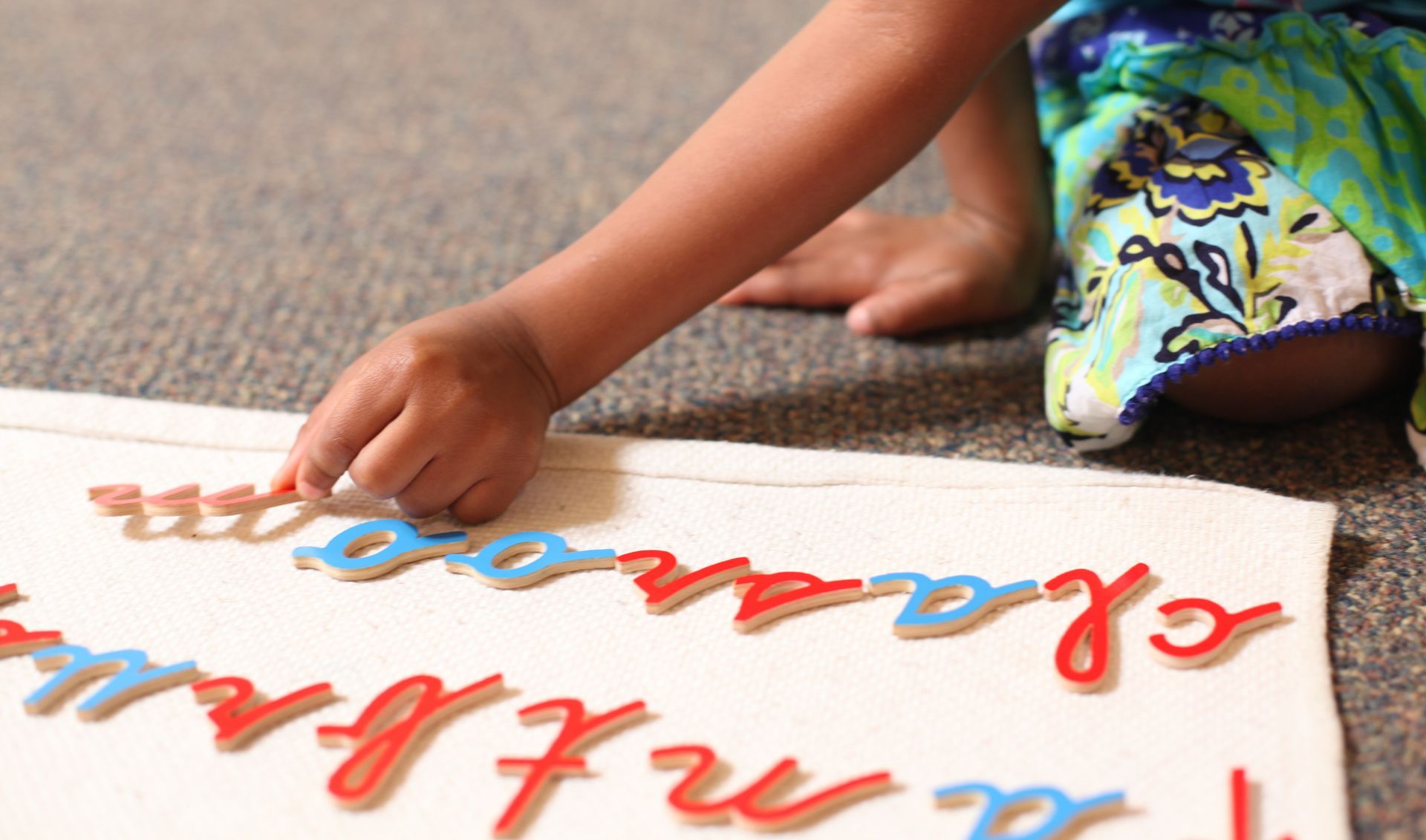
The Movable Alphabet: This beloved material is a wooden box filled with individual letters—the literal building blocks of our language. It allows a child who cannot yet grip a pencil to joyfully write entire paragraphs, stories, and poems on a floor mat by arranging the symbols phonetically. Their mind is fully liberated to compose while their hand continues to mature at its own natural pace.
3. Interpretive Reading: Decoding the Thoughts of Others
If writing is an expression of one's own mind, reading is an act of interpretation. When a child reads, they must look at abstract symbols, match the correct phonetic sounds to them, blend those sounds together smoothly, and then attach meaning to a concept someone else created. It is a highly complex cognitive task.
Just as the hand must be prepared for writing, the eye must be carefully prepared for reading. At Seeds of Life, this preparation happens organically across the senses:
- Visual Tracking: To read smoothly, the eye must comfortably master a left-to-right, top-to-bottom tracking progression.
- Visual Discrimination: Before distinguishing between a 'b' and a 'd', a child’s eye must practice recognizing subtle differences in lines and shapes. Materials like the Geometry Cabinet and other Sensorial works directly refine this visual discrimination.
- The Sandpaper Letters: We introduce the phonetic sounds of our language through three simultaneous pathways: tactile, visual, and auditory. Children trace the highly textured sandpaper shape using a gross motor movement of their whole arm, see the form, and hear the corresponding sound. They quite literally use muscle-memory to learn the alphabet.
As children naturally progress from reading isolated nouns to parsing complete sentences, they explore games that highlight word functions (grammar) and sentence structures. This deep, analytical understanding ensures that when they read, they aren't just pronouncing words—they are truly interpreting the author’s intent.
The Human Blueprint Woven into Daily Rhythms
The beautiful progression your child experiences—moving from spoken language, to written expression, to interpretive reading—perfectly mirrors the historical evolution of human civilization. Early humans communicated spoken words for millennia, advanced into written symbols (like cave paintings and hieroglyphics), and eventually learned to read and interpret the recorded thoughts of history.
At Seeds of Life, this grand human blueprint is woven seamlessly into our everyday practical life and sensorial tasks. For instance, when a child independently dusts a shelf or washes a table, they are naturally training their eyes to track automatically from left to right and top to bottom, directly preparing them for text tracking on a page.
Similarly, when they explore the rough and smooth boards or touch tablets, they cultivate a sophisticated lightness of touch and sensory awareness in their fingertips that is essential for fluid pencil control later on. Even the simple act of grasping the small wooden knobs of the cylinder blocks serves as a purposeful, indirect preparation, naturally strengthening the three-finger pincer grasp long before a child ever holds a writing instrument. Combined with intentional phonetic games like "I Spy," which builds critical phonemic awareness, every corner of our prepared environment quietly collaborates to lay the groundwork for your child's emerging literacy.
Trusting the Spontaneous Explosion
The true genius of this methodology is that it completely deconstructs complex academic milestones into isolated, joyful, and manageable pieces of work. By the time a child is introduced to a pencil or a phonetic reader, they have already mastered every component skill required. The final integration feels completely spontaneous—the child suddenly realizes, with immense pride and independence, "I can write! I am reading!"
Once this beautiful explosion occurs, an entirely new journey of cosmic discovery begins. The child is no longer just practicing a skill; they are using literacy as a key to unlock the wonders of history, science, and the world around them.
Experience the Magic in Practice
At Seeds of Life, our classrooms function as a living practice environment where these daily miracles of development unfold in real time. We invite you to step into our space, observe our beautiful materials, and witness the joyous journey of literacy firsthand.
Schedule a tour to learn more about our Casa environments.