The Quiet Landing: Why Children Need Time After School

The Quiet Landing: Why Children Need Time After School

When we pick up our children from school, it’s almost automatic to ask, “How was your day?”
 

And just as automatically, the answers tend to fall flat: fine, good, okay, or sometimes nothing at all.


As adults, we can probably relate. When someone asks about our day, we don’t always feel like revisiting every detail, especially before we’ve had a chance to rest or reset. For children, this challenge is even greater.


In Montessori environments, children are immersed in experiences that are rich, complex, and often difficult to put into words. How does a young child explain the sensorial experience of carefully carrying each cube of the Pink Tower across the room? Or describe the quiet satisfaction of discovering that ten tens create a hundred square? Or articulate the subtle social negotiations that happen during community lunch?


Even for older children, language often lags behind experience.


Why “How Was Your Day?” Can Feel Like Too Much


As children move into the elementary years, they are also navigating peer relationships that are still very black and white. A single interaction can color their entire perception of the day. So their reports may sound overly simple: someone was mean, someone was nice, the day was bad, the day was good.

But often, the issue isn’t that children don’t want to share. Instead, the timing is off.


Research on children’s nervous systems helps explain why. When children walk out of school, their brains are often still in a state of high alert. Throughout the day they’ve managed noise, social expectations, concentration, corrections, and constant stimulation. Their nervous system hasn’t fully shifted out of “school mode” yet.


So it helps if we remember that we aren’t greeting children in their most rational state.


Those first minutes after pickup are a transition, not a conversation window. When we jump in with questions too quickly, even well-meaning ones, we may unintentionally overwhelm our children’s nervous system, which hasn’t had time to settle.


Connection Before Conversation


In Montessori, we place great importance on transitions. We know children need time to move from one state of being to another, whether that’s arriving at school, moving between activities, or going home at the end of the day.

Instead of starting with questions, we can start with presence.


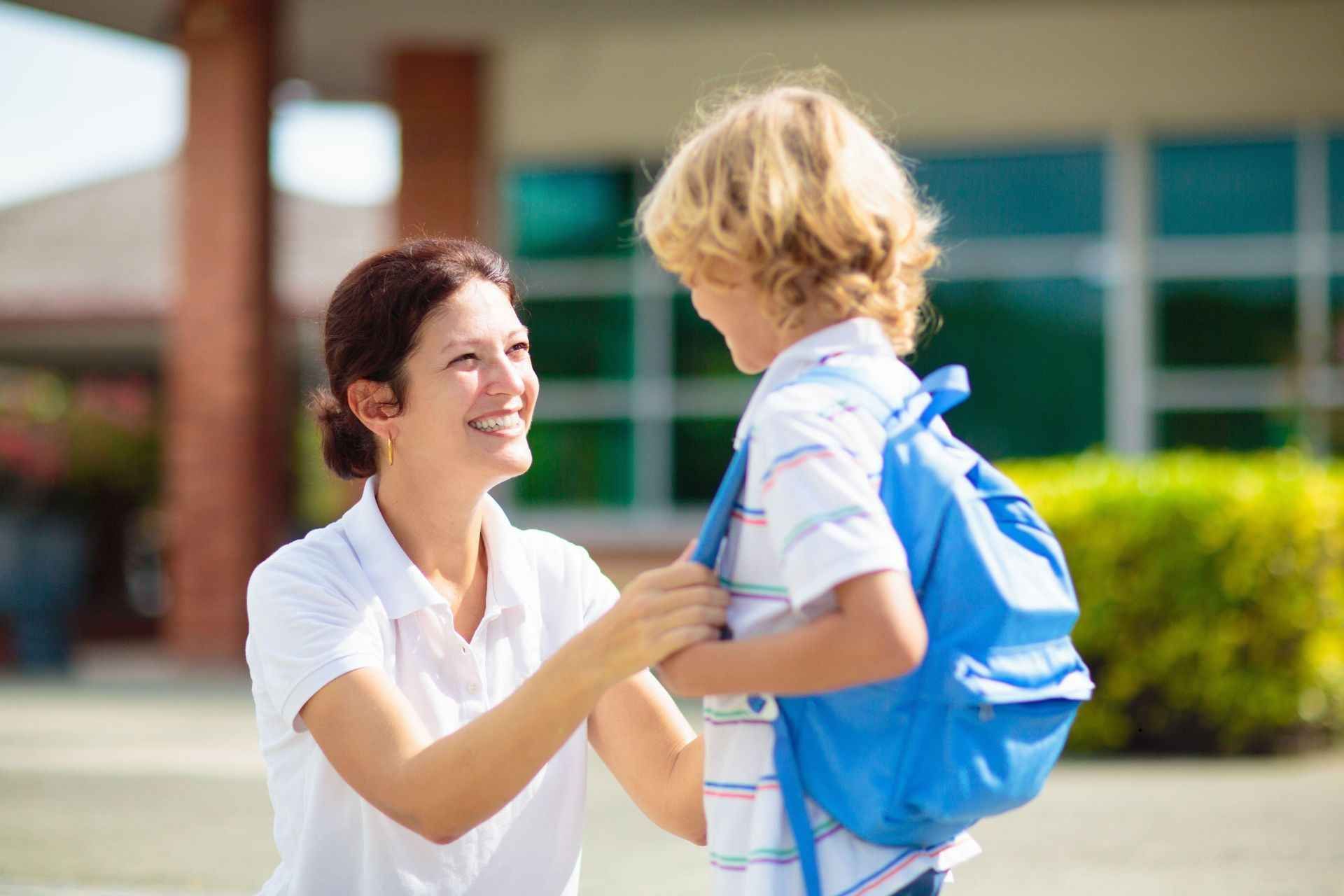
When we first see our children, a warm greeting that communicates “I’m happy to see you” goes a long way. Some children need a snack. Some need quiet. Some need movement, proximity, or simply space. This is not the moment to gather information. This is the moment to re-establish connection.


When families allow even 10 to 12 minutes of quiet decompression after school, through silence, music, or simply being together, children regulate more quickly. Evening stress decreases, cooperation improves, and children are more likely to talk voluntarily later on.


Rather than interrogating right after school. Try coexisting. This pause is deeply respectful.


When Children Are Ready to Talk


Later, after your child has had time to settle back into your care, you may notice that conversation begins naturally. This is often when children share what mattered most to them, not what we might have thought to ask about.

When you do open the door to conversation, gentle specificity helps. Broad questions like “How was your day?” can feel overwhelming. Instead, try comments that invite reflection without pressure:


●     “I noticed you seemed really focused when I picked you up.”

●     “I’m here if you want to tell me about something you worked on today.”

●     “What felt good about today?”

Just as important as the words is our availability. Putting down the phone, pausing the logistics, and showing with our body language that we are truly listening makes it safer for children to share.


Listening for Timing, Not Just Content


This approach applies across ages. Even adolescents benefit from what some call a “quiet landing” after school. When we honor timing, we’re less likely to walk into the emotional residue of the day and more likely to build cooperation and connection later.


In Montessori, we often say: regulation comes before reflection. Children don’t need us to extract their feelings. They need us to create the conditions where feelings can land safely.


Sometimes that looks like silence. Sometimes it looks like presence. And sometimes, after enough space has been given, it looks like a child finally saying exactly what mattered most.


So the question isn’t just “Do I listen to what my child says?” And instead becomes: “Do I listen for when they’re ready to speak?”
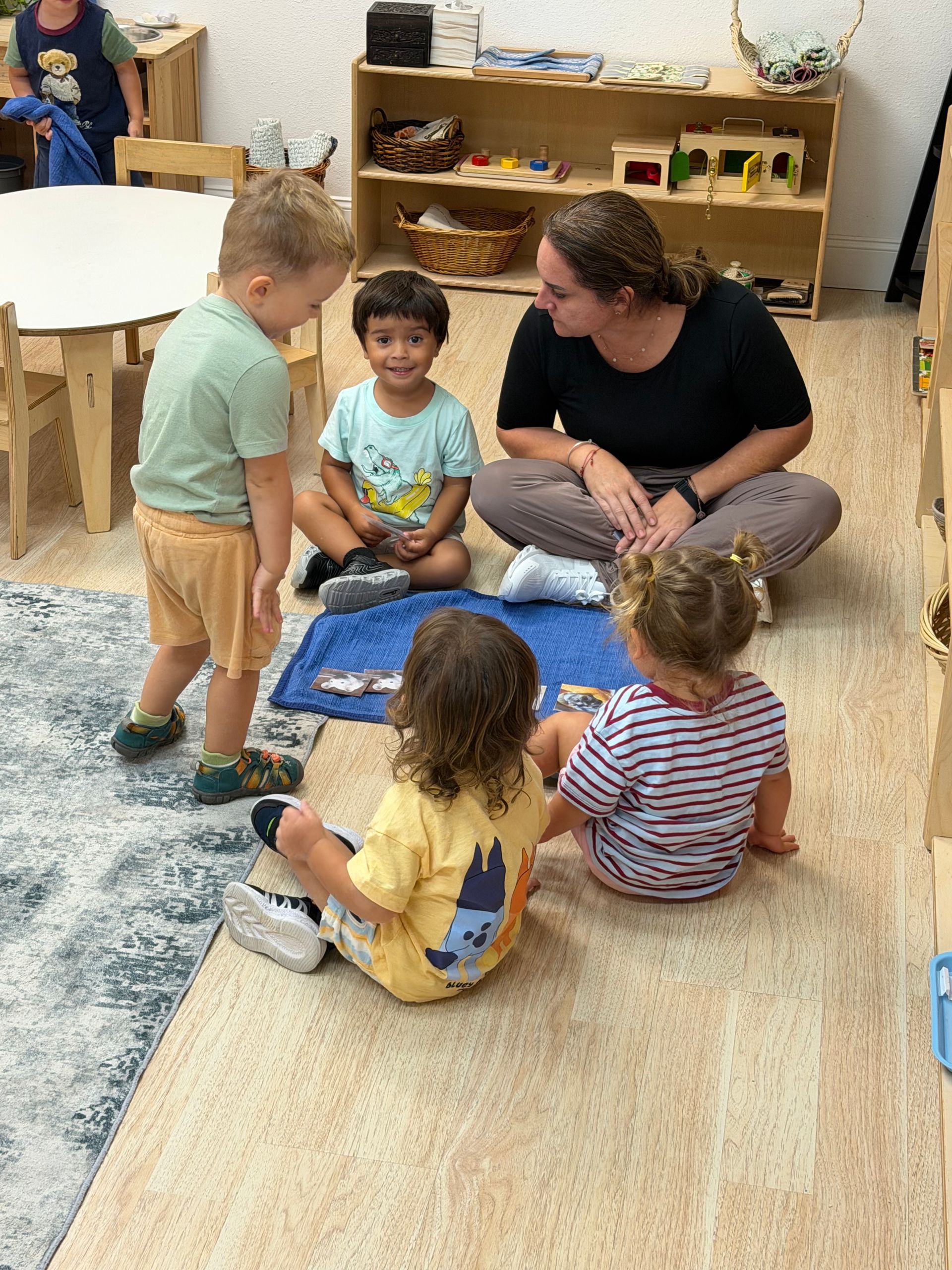
 

Two children kneel on a rug, reaching into a wooden puzzle board together.
By Jeff Chaffin July 21, 2026
In an era where many families seek personalized, child-centered education, homeschooling has seen significant growth. Parents value the flexibility, deep family bonds, individualized pacing, freedom from screens, and nurturing of intrinsic motivation that homeschooling can provide. These aspirations lie at our core. At Seeds of Life Montessori Academy (SOL Montessori) in Sarasota, Florida, our authentic Montessori program—rooted in over 150 years of proven methodology—mirrors many of homeschooling's core values while addressing common challenges through professional expertise, community, and resources that most home environments find difficult to replicate consistently. Shared Foundations: Child-Led Learning and Independence Both homeschooling and Montessori education prioritize the child as an active participant in, their own development rather than a passive recipient of instruction. Homeschool families often follow the child's interests, allowing deep dives into topics at their own pace. Similarly, Montessori classrooms embody Dr. Maria Montessori's principle of "follow the child." Teachers prepare an environment rich with hands-on materials that invite exploration, then step back to observe and guide as needed. At SOL Montessori, this looks like children choosing work that captivates them—whether mastering practical life skills like food preparation (echoing homeschool kitchen involvement) or exploring geography with geo specific physical artifacts that ignite imagination. Our bilingual (English-Spanish) immersive environment further supports cultural awareness and language acquisition in a natural, family-like way. Practical life activities are a hallmark in both approaches. AMS (American Montessori Society) resources highlight how parents can incorporate Montessori-style self-care and household tasks at home, such as folding laundry or meal prep with real tools. Since SOL Academy is a verified AMS school, committed to high-fidelity Montessori practices in our classrooms, these activities are daily norms, scaled to the child's abilities, fostering confidence and responsibility without external rewards or punishments—nurturing the intrinsic motivation many homeschool parents cherish. The Power of Relationships and Community Homeschooling often strengthens family bonds through dedicated time together. Montessori extends this by creating a "family-like" multi-age community. Our 3-year age cycles (e.g., ages 3- 6 in Primary, 1st-3rd grade in Junior Elementary, etc.) allow children to form deep, consistent relationships with teachers and peers—older children mentor younger ones, reinforcing learning through teaching, while younger ones gain inspiration. This mirrors sibling dynamics at home while scaling those benefits to a broader, diverse peer group. Children build essential social skills, empathy, and collaboration in ways that a single-family setting often finds difficult to sustain consistently amid the varying rhythms, transitions, and scheduling commitments. SOL Montessori maintains an average 7:1 teacher-to-child ratio , enabling highly individualized attention. Our dedicated teachers and supportive administrative structure allow for truly personalized instruction tailored to each child—support that even the most committed homeschooling parents, while balancing multiple children, household responsibilities, or work demands, can find challenging to sustain at the same level of consistency and depth. Expertise and Individualized Support. One of homeschooling's strengths is tailored support, but it can be challenging for parents without specialized training to address diverse sibling needs consistently, especially in areas like neurodiversity. SOL Montessori's teachers hold AMS-aligned credentials involving extensive coursework, practicum, and ongoing professional development—significantly surpassing standard requirements and placing them among the most highly prepared educators in early and elementary education. Our founder, Maria Eva Chaffin, brings deep expertise as an inclusion specialist, with advanced degrees, doctoral research on how to support educators and teams to achieve the best possible individual outcomes for every child, and thousands of hours working child development specialist and educators around the world. Maria regularly shares her experience and resources via @montessori_behavior on Instagram. Through our sister organization, Montessori Behavior, Maria and the SOL team provide training and consulting to teachers and administrators around the world. Maria is now a sought-after international consultant and speaker and SOL Montessori Academy serves as a model school for other chools and academies globally that are seeking to leverage the success of SOL within their own organizations. Teacher preparation—including professionally, mentally, and emotionally—plays one of the most critical roles in early childhood development and education. With this extensive in-house expertise and experience, SOL teachers create a truly unique environment where every child feels secure, loved, and free to explore their passions with confidence. This foundation of co-regulation, nervous system awareness (drawing on Maria’s extensive training and research on the polyvagal theory), and deep understanding of child development, empowers the team to enable every child to thrive authentically. Montessori's research-backed methods align with modern neurology, emphasizing hands-on materials over screens. We prioritize real-world interaction, nature integration, and minimalism —reducing overstimulation while maximizing focus and joy. Addressing Homeschooling Challenges  While homeschooling offers flexibility, families often cite isolation, limited socialization opportunities, inconsistent access to specialized materials, parental burnout, gaps in advanced subjects or extracurriculars, and the extensive travel and car time required to shuttle between various activities and functions as hurdles. Many also experience the constant pressure to manage or negotiate screen time—whether as a reward, distraction during transitions, or to fill scheduling gaps—which can conflict with desires for screen-free, hands-on learning. SOL Montessori complements or serves as a robust alternative: Proven Curriculum & Materials: 150+ years of refinement with self-correcting, sequential materials that "teach" independently while teachers facilitate. Community & Socialization: Multi-age classrooms provide natural peer modeling and friendship-building. Sustainability for Families: Professional educators handle daily instruction, freeing parents to be emotionally available for their children while drastically increasing the quality of family interaction , advocacy, or work. No Screens Emphasis: Deep, tactile learning that builds concentration and creativity. Bilingual & Inclusive Excellence: Tailored support in a diverse, welcoming setting serving Sarasota-area families. Parents partnering with us often report the best of both worlds: Montessori at school reinforcing homeschool values at home, with easy extensions via AMS parent resources and SOL parent educational events. Why Choose SOL Montessori for Your Homeschool-Minded Family? If you're drawn to homeschooling for its personalization, independence, and whole-child focus, Seeds of Life Montessori Academy offers a proven, professional embodiment of those ideals— plus the infrastructure, expertise, and community that amplify outcomes. Our approach ensures mevery child, including those with unique needs, receives the support to flourish. We invite you to schedule a tour and see the calm, purposeful environment where children lead with joy and purpose. Discover how our model school can partner with your family’s vision.
By Maria Eva Chaffin July 21, 2026
When I speak about inclusion in Montessori, I do not speak about it as a modern idea placed on top of the method. I speak about it as a return to one of the deepest roots of Montessori’s work: the belief that the child must be observed before being judged, and that the adult must be prepared before claiming to know what the child can or cannot do. The conversation about learning differences in Montessori often becomes too simple. Some say that the first Children’s House was not created for children with disabilities. Historically, that statement is true in one sense. The Casa dei Bambini in San Lorenzo was not established as a special education school. It was born within a social reform project for young children living in a working-class community in Rome. But if we stop there, we risk separating the Children’s House from the earlier work that formed Montessori’s scientific and pedagogical vision. Maria Montessori did not arrive in San Lorenzo with an empty method. Before the first Children’s House opened in 1907, Montessori had already studied medicine, anthropology, experimental psychology, and pedagogy. She had also worked with children who, in the medical language of her time, were called “deficient,” “abnormal,” or “phrenasthenic.” Today, we would use more respectful and accurate language: children with developmental disabilities, intellectual disabilities, learning differences, and neurodevelopmental needs. The language has changed, and it should change, but the historical fact remains important. Montessori’s method was shaped, in part, by children who had been excluded from ordinary education. In The Montessori Method, Montessori explains that the educational system used in the Children’s Houses “sprang from preceding pedagogical experiences with abnormal children” (Montessori, 1912, p. 31). She also writes that “mental deficiency presented chiefly a pedagogical, rather than mainly a medical, problem” (Montessori, 1912, p. 32). These statements matter because Montessori was not denying disability, nor was she romanticizing the child’s needs. She was challenging the assumption that the child’s difficulty belonged only inside the child. She was asking educators to look also at the method, the adult, the environment, and the opportunities for development. This is where Montessori’s connection to Jean-Marc Gaspard Itard and Édouard Séguin becomes essential. Montessori studied their work carefully. Itard’s work with sensory education and observation, and Séguin’s physiological method, helped Montessori understand that education could begin through the body, the senses, movement, and concrete experience. Séguin’s work was especially important because he challenged the idea that children with intellectual disabilities were unreachable. His method began where the child was, not where the adult wished the child would be. Séguin’s own words help us understand this foundation. In Idiocy: And Its Treatment by the Physiological Method, he argued that the educational treatment of the child must begin from the child’s present point of development. This idea is profoundly connected to the Montessori principle of following the child. It is also profoundly connected to inclusion. The adult does not begin with a fixed program and force the child into it. The adult begins by studying the child’s development and preparing the next possible step. Montessori took this inheritance and transformed it. She did not simply apply Séguin’s work mechanically. She brought it into a larger vision of education, freedom, observation, independence, and human development. In The Montessori Method, she explains that her work in the Children’s Houses represented trials made with methods already used with children then called “deficients, ” while also clarifying that her work was not merely a direct application of Séguin. This nuance matters. The Orthophrenic School and the Children’s House were not the same context, but they were not unrelated. The roots of Montessori education include the study of children who had been misunderstood, underestimated, and excluded. Paola Trabalzini’s historical work in Maria Montessori Through the Seasons of the “Method” helps us hold this nuance with greater accuracy. Trabalzini places Montessori’s early work with children then called “phrenasthenic” within the formation of her scientific pedagogy. She also explains that when Montessori accepted the work in San Lorenzo, she brought with her the hypothesis of trying, with so-called “normal” children, the sensorial materials she had already used with children considered mentally deficient in the language of that time. This does not mean the Children’s House was a special education classroom. It means the method Montessori brought into the Children’s House had already been shaped by children who did not fit the expectations of traditional schooling. For me, this is one of the strongest foundations for understanding Montessori inclusion. Inclusion is not simply about placing a child in a classroom. Inclusion is not pretending that every environment can meet every need without support, training, collaboration, staffing, or adjustment. That would be irresponsible. But exclusion based on labels, without deep observation and without examining the adult and the environment, is also not Montessori. Montessori warned us about the danger of lowered expectations. In The Montessori Method, she wrote that when an educator accepts the idea that they are educating an “inferior personality, ” “for that very reason he does not succeed” (Montessori, 1912, p. 37). This is one of the most important sentences for the work I do today. Before a child is limited by a diagnosis, a behavior, or a difficulty, the child may already be limited by what the adult has decided is possible. This is not a small problem. It is one of the deepest barriers to true inclusion. This is why my work always returns to the prepared adult. The prepared adult is not simply the adult who knows the lessons or can present the materials correctly. The prepared adult is the person willing to examine assumptions, reactions, expectations, and the state of the nervous system. When an adult is dysregulated, the adult does not observe clearly. The adult reacts. The adult controls. The adult may interpret sensory overwhelm as defiance, executive function difficulty as laziness, fear as manipulation, or communication differences as disrespect. In those moments, the child is no longer being observed. The child is being interpreted through the adult’s activation. Montessori may not have used today’s language of nervous system regulation, sensory processing, trauma, or executive functioning, but she understood that the adult’s inner preparation mattered. In The Discovery of the Child, she writes about the spiritual preparation of the teacher and the need for the adult to remove pride and anger in order to see the child more clearly. In the chapter where she reflects on the adult’s inner obstacles, Montessori’s language is strong because she understood that the adult can become the greatest barrier to the child’s development. Today, we can understand that through both Montessori philosophy and current knowledge about the nervous system. A dysregulated adult does not create safety. A reactive adult does not create freedom. An unprepared adult may turn the Montessori environment into a place of compliance rather than development. This is also why Dr. Montessori’s Own Handbook is important for this conversation. Montessori describes the Children’s House as “the environment which is offered to the child that he may be given the opportunity of developing his activities” (Montessori, 1914, p. 15). She adds that this kind of school “is not of a fixed type, ” but may vary according to the resources and opportunities of the environment (Montessori, 1914, p. 15). She then says that it “ought to be a real house” (Montessori, 1914, p. 15), a place where children are not merely placed inside an adult institution, but where the environment is adapted to their life, movement, independence, and development. That statement matters for inclusion because it reminds us that Montessori is not a fixed aesthetic. It is not only a shelf, a rug, or a perfect room. The Children’s House is an environment prepared for life. If the environment is truly prepared for the child, then we must ask whether it responds to the child’s actual developmental needs, not just to an idealized image of the Montessori child. A real house must be livable for the children who are actually there. In the same handbook, Montessori explains that the child’s development involves both motor and sensory functions. Through motor functions, the child secures balance, learns to walk, and coordinates movement. Through sensory functions, the child receives impressions from the environment and builds the foundations of intelligence through observation, comparison, and judgment. This is where Montessori’s roots in Séguin’s work are still visible. Development is not only intellectual. It begins in the body. It begins through movement and through the senses. It begins through the child’s interaction with a prepared environment. This connection is deeply aligned with what I see in my work with neurodivergent children and Montessori educators today. A child’s behavior is often communication from the nervous system. Movement, sensory seeking, avoidance, impulsivity, shutdown, difficulty with transitions, or emotional intensity are not signs that the child does not belong. They are information. They tell us something about the child’s regulation, development, environment, and support needs. The prepared adult must learn to read that information without immediately turning it into judgment. This does not mean the adult ignores limits, safety, or the needs of the group. Montessori inclusion is not permissiveness. It is not the absence of structure. It is the presence of deeper preparation. It asks the adult to understand the difference between a child who is refusing and a child who is unable in that moment. It asks the adult to notice when the environment is too loud, too fast, too abstract, too socially demanding, or too dependent on executive functioning skills the child has not yet developed. It asks the adult to collaborate with families and specialists without seeing that collaboration as a failure of Montessori. Responsible inclusion requires humility. It requires us to admit that some children need support beyond what a classroom currently has. It requires school leaders to be honest about training, staffing, expectations, and resources. But it also requires us to resist the temptation to protect the method by excluding the child too quickly. If Montessori’s own method was shaped by children who were considered outside the reach of ordinary education, then we should be very careful when we use Montessori language to decide who belongs. The deeper meaning of inclusion is not that every placement is automatically right. The deeper meaning of inclusion is that every child deserves to be studied with dignity before decisions are made about what is possible. Inclusion asks us to observe the child, prepare the environment, prepare the adult, and examine the systems around the child. It asks us to see development as dynamic, not fixed. It asks us to remember that the child’s difficulty may reveal not only the child’s need, but also the adult’s need for more preparation. This is why I say that Montessori inclusion begins with the prepared adult. The adult is not only managing behavior. The adult is preparing conditions for development. The adult is learning to regulate, to observe, to adapt, to collaborate, and to protect the dignity of the child without denying the reality of the child’s needs. In this sense, inclusion is not outside Montessori. Inclusion is what happens when we take Montessori seriously enough to apply it to the child who does not make our work easy. Montessori’s roots do not give us simple answers, but they do give us a serious responsibility. They remind us that the method grew from scientific observation, from work with children who had been excluded, from the education of the senses and movement, and from the transformation of the adult. If we want to speak about Montessori and learning differences today, we must speak with that history in mind. The question is not whether inclusion belongs in Montessori. The deeper question is whether we are prepared enough, as adults and as institutions, to practice Montessori with the children who require us to observe more carefully, prepare more deeply, and transform ourselves more honestly. References Itard, J. M. G. (1962). The wild boy of Aveyron (G. Humphrey & M. Humphrey, Trans.). Appleton-Century-Crofts. (Original work published 1801) Montessori, M. (1912). The Montessori method: Scientific pedagogy as applied to child education in “The Children’s Houses” (A. E. George, Trans.). Frederick A. Stokes Company. (Original work published 1909) Montessori, M. (1914). Dr. Montessori’s own handbook. Frederick A. Stokes Company. Montessori, M. (1967). The discovery of the child (M. J. Costelloe, Trans.). Ballantine Books. (Original work published 1948) Séguin, E. (1866). Idiocy: And its treatment by the physiological method. William Wood & Company. Trabalzini, P. (2011). Maria Montessori through the seasons of the “method.” The NAMTA Journal, 36(2). North American Montessori Teachers’ Association.