When you visit a toddler or primary environment at Seeds of Life Montessori Academy, you will notice carefully prepared, self-correcting materials designed to refine the five traditional senses—sight, touch, hearing, smell, and taste. However, Dr. Maria Montessori recognized that children possess another extraordinary cognitive ability: the stereognostic sense.
What is the Stereognostic Sense?
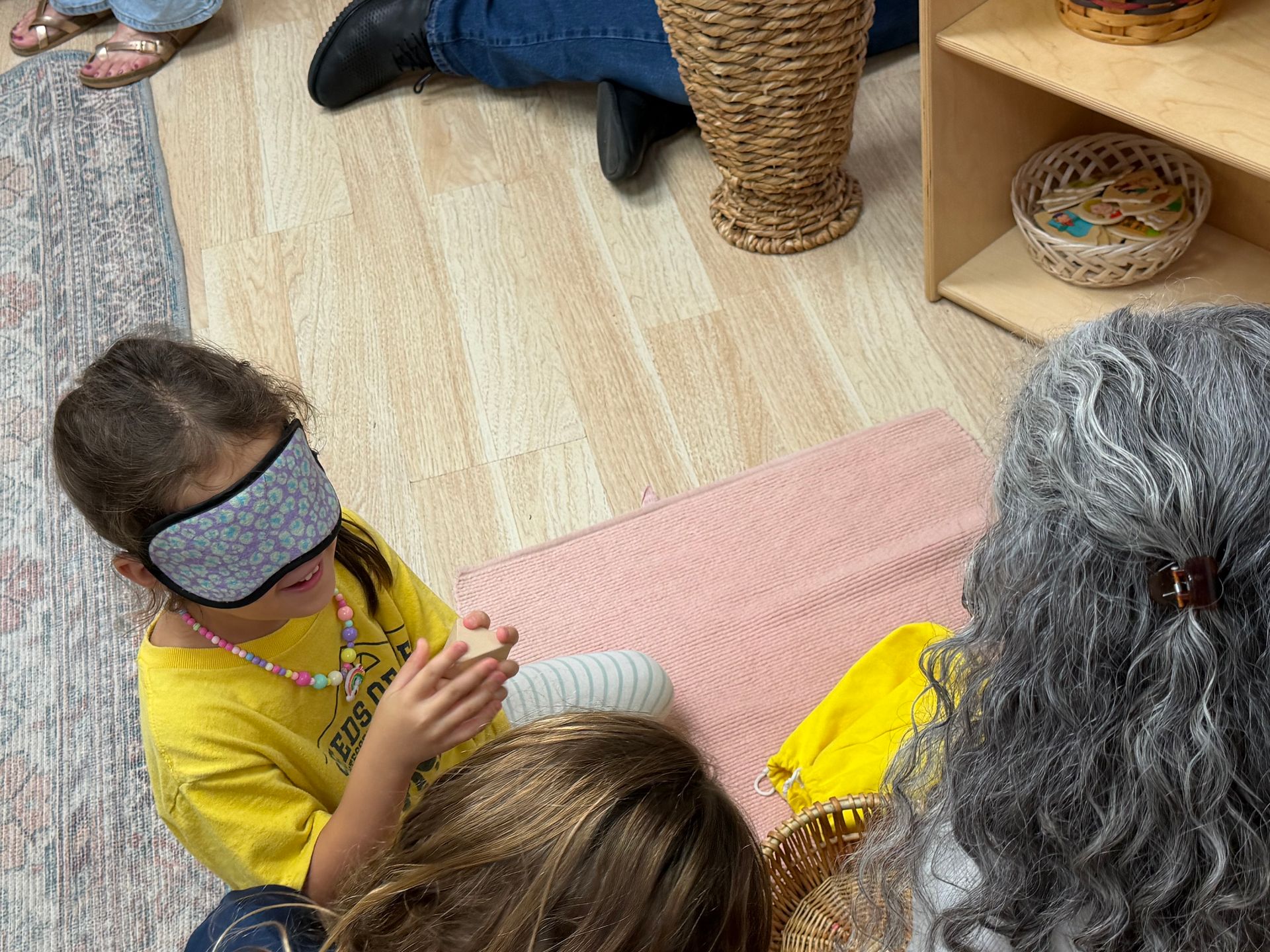
The term stereognostic stems from the Greek words stereo (“around” or “solid”) and gnosis (“knowledge”). Having a stereognostic sense means being able to recognize the shape, size, texture, and identity of a three-dimensional object purely through tactile manipulation—without any visual or auditory input.
"They are very proud of seeing without eyes, holding out their hands and crying, 'Here are my eyes!' 'I can see with my hands!'"
— Dr. Maria Montessori, The Montessori Method
Through the combined movement of their hands and muscles, young children build a mental image of an object. This tactile and muscular experience creates a physical memory in the brain.
Because young children absorb their environment with immense intensity, rich physical experiences lead to more accurate perceptions. By pairing precise language (naming objects) with tactile and muscular memory, children develop a complete, integrated understanding of the world around them.
The Mystery Bags (Stereognostic Work)
In our Casa classrooms, we introduce specialized "mystery bags" (or stereognostic bags) to nurture this emerging sense. These simple drawstring pouches contain familiar objects from the child's daily environment, ensuring they already possess the vocabulary for each item.
We introduce these materials in a thoughtful, sequential order:
- Categorized Sets: The first bag contains four to six objects belonging to a specific group, such as real kitchen utensils, art tools, or grooming items used in daily life.
- Uncategorized Collections: The second bag features four to six distinct, unrelated objects (e.g., a natural sea sponge, a smooth river rock, a small funnel, a wooden comb, or a piece of velvet cloth).
- Matching Pairs: The third bag contains three to four distinct pairs of identical objects, encouraging the child to match items purely by feel.
The Experience: How We Present the Mystery Bag
When presenting a mystery bag, a guide invites the child to a table and carefully demonstrates how to open and close the drawstring, allowing the child a turn to practice. Next, the guide removes each item one by one, naming it clearly and offering it to the child to touch and explore. Once all items are placed on the table, the guide names each object again as it is returned to the bag.
Then, the magic begins!
- The guide announces that they will find a specific item using only their hands.
- Reaching both hands into the bag without looking, the guide feels around the shapes.
- With enthusiasm, the guide names the object before pulling it out, displaying it to the delighted child.
- The guide repeats this process before inviting the child to take their turn.
- For paired objects, the guide removes one item, names it, and then reaches back inside the bag to feel for its exact match.
We rotate these objects regularly to keep the work fresh, engaging, and challenging. Children find this activity captivating!
The Neurological Impact
When a child identifies an object through touch alone, their brain receives complex tactile and proprioceptive input. It processes movement, pressure, weight, and texture, fusing these signals into a clear mental image.
"When the hand and arm are moved about an object, an impression of movement is added to that touch. Such an impression is attributed to a special, sixth sense, which is called a muscular sense, and which permits many impressions to be stored in a 'muscular memory,' which recalls movements that have been made."
— Dr. Maria Montessori, The Discovery of the Child
By connecting touch, movement, and language, the stereognostic sense strengthens neural pathways, builds focus, and lays the groundwork for abstract reasoning and executive function.
The mystery bags are just one example of the intentional, research-backed materials found throughout our prepared environments.
Schedule a tour at Seeds of Life Montessori Academy today to see how our hands-on curriculum nurtures deep learning!