Elementary Story: How Geometry Got Its Name

In Montessori elementary classrooms, we like to introduce big ideas with big stories. We offer children a sense of wonder first, sort of like an imaginative doorway, so that when they later study formulas, theorems, and proofs, they already feel connected to the human story behind them.


One of these stories is The Story of How Geometry Got Its Name, an introduction to a subject that is far older than the textbooks and protractors we encounter today. In Montessori, Geometry is more than about shapes. It is about human beings solving real problems in the real world.


A Problem as Old as Civilization


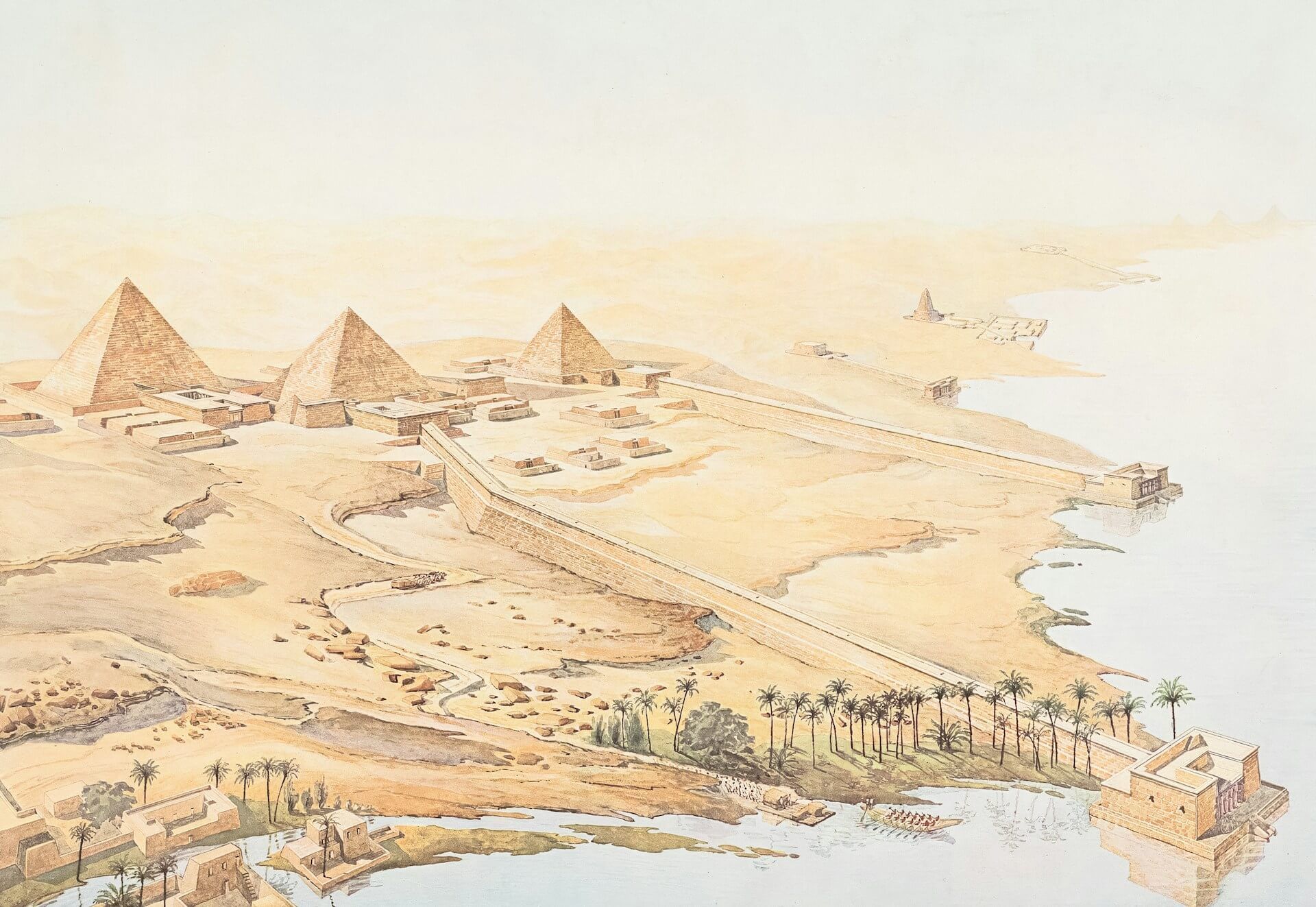
To introduce geometry, we take children about five thousand years back in time to the ancient civilization of Egypt. This was a land shaped by the , the longest river in the world. Each year, the Nile flooded its banks as snowmelt poured down from the mountains far to the south. The Egyptians depended on this yearly flood as it left behind rich, dark silt that nourished their crops and made life possible in an otherwise harsh desert.


But the flood created a challenge, too. It washed away the boundary markers that separated one farmer’s field from another. When the waters receded, no one could quite remember where their land began and ended. Arguments ensued. “This corner is mine!” And the fields needed to be measured and marked again.


The First Geometers: The Rope Stretchers


To solve this annual problem, the Egyptians relied on a special group of skilled workers called the Harpedonaptai, or Rope Stretchers. These were early land surveyors who used a knotted rope tied at regular intervals and three weights to create a very particular triangle.


In the classroom, we invite a few children to hold a prepared rope at its large knots, forming that same triangle. As they stretch it out and lay it on the ground, many quickly recognize what the Egyptians had unknowingly created: a scalene right-angled triangle. This shape would later become central to the geometry studied by Greek mathematicians.


The Rope Stretchers used this simple tool to re-establish field boundaries, set right angles, and make sure the land was measured accurately and fairly. Geometry, in its earliest form, served a deeply practical purpose.


From Rope to Pyramid


The Rope Stretchers’ expertise was valued far beyond the farmlands. They also helped lay out the foundations of temples, monuments, and even the Great Pyramid of Giza. The base of the Great Pyramid is a perfect square, which is an astonishing feat of measurement and design. The Pharaoh himself oversaw these measurements, but it was the Rope Stretchers who executed them.


Their work represents one of humanity’s earliest recorded sciences: the careful measuring of the earth.


How Geometry Got Its Name


The name geometry reflects this ancient practice. It comes from two Greek words:


— earth

metron — measure


Geometry literally means earth measurement.


The Egyptians did not use the language of right angles, nor did they classify triangles as we do today. Their work was grounded in practical needs. They needed to solve problems, organize land, and create structures that would endure for thousands of years. Yet their discoveries influenced later thinkers like Pythagoras, who likely traveled to Egypt and learned from their methods. Over time, the simple knotted rope inspired a whole discipline devoted to understanding lines, angles, shapes, and the relationships between them.


Why We Tell This Story in Montessori


When Montessori children hear this story, something important happens. Geometry becomes more than a set of rules or vocabulary words. It becomes a human endeavor born from curiosity, necessity, and ingenuity.


This is the heart of Montessori’s cosmic education: helping children see knowledge not as isolated subjects, but as gifts from generations before them. When children pick up a ruler, explore angles with a protractor, or classify triangles in the classroom, they are continuing a legacy that began with those early Rope Stretchers on the banks of the Nile.


Through story, children feel connected to the people who shaped our world and to the problems that inspired great ideas. Schedule a tour today to see how geometry becomes meaningful, purposeful, and alive for our children here in Sarasota, Florida.
July 27, 2026
The Metal Insets are one of Montessori's most misunderstood materials. They look simple. They are doing something extraordinary.
Two children kneel on a rug, reaching into a wooden puzzle board together.
By Jeff Chaffin July 21, 2026
In an era where many families seek personalized, child-centered education, homeschooling has seen significant growth. Parents value the flexibility, deep family bonds, individualized pacing, freedom from screens, and nurturing of intrinsic motivation that homeschooling can provide. These aspirations lie at our core. At Seeds of Life Montessori Academy (SOL Montessori) in Sarasota, Florida, our authentic Montessori program—rooted in over 150 years of proven methodology—mirrors many of homeschooling's core values while addressing common challenges through professional expertise, community, and resources that most home environments find difficult to replicate consistently. Shared Foundations: Child-Led Learning and Independence Both homeschooling and Montessori education prioritize the child as an active participant in, their own development rather than a passive recipient of instruction. Homeschool families often follow the child's interests, allowing deep dives into topics at their own pace. Similarly, Montessori classrooms embody Dr. Maria Montessori's principle of "follow the child." Teachers prepare an environment rich with hands-on materials that invite exploration, then step back to observe and guide as needed. At SOL Montessori, this looks like children choosing work that captivates them—whether mastering practical life skills like food preparation (echoing homeschool kitchen involvement) or exploring geography with geo specific physical artifacts that ignite imagination. Our bilingual (English-Spanish) immersive environment further supports cultural awareness and language acquisition in a natural, family-like way. Practical life activities are a hallmark in both approaches. AMS (American Montessori Society) resources highlight how parents can incorporate Montessori-style self-care and household tasks at home, such as folding laundry or meal prep with real tools. Since SOL Academy is a verified AMS school, committed to high-fidelity Montessori practices in our classrooms, these activities are daily norms, scaled to the child's abilities, fostering confidence and responsibility without external rewards or punishments—nurturing the intrinsic motivation many homeschool parents cherish. The Power of Relationships and Community Homeschooling often strengthens family bonds through dedicated time together. Montessori extends this by creating a "family-like" multi-age community. Our 3-year age cycles (e.g., ages 3- 6 in Primary, 1st-3rd grade in Junior Elementary, etc.) allow children to form deep, consistent relationships with teachers and peers—older children mentor younger ones, reinforcing learning through teaching, while younger ones gain inspiration. This mirrors sibling dynamics at home while scaling those benefits to a broader, diverse peer group. Children build essential social skills, empathy, and collaboration in ways that a single-family setting often finds difficult to sustain consistently amid the varying rhythms, transitions, and scheduling commitments. SOL Montessori maintains an average 7:1 teacher-to-child ratio , enabling highly individualized attention. Our dedicated teachers and supportive administrative structure allow for truly personalized instruction tailored to each child—support that even the most committed homeschooling parents, while balancing multiple children, household responsibilities, or work demands, can find challenging to sustain at the same level of consistency and depth. Expertise and Individualized Support. One of homeschooling's strengths is tailored support, but it can be challenging for parents without specialized training to address diverse sibling needs consistently, especially in areas like neurodiversity. SOL Montessori's teachers hold AMS-aligned credentials involving extensive coursework, practicum, and ongoing professional development—significantly surpassing standard requirements and placing them among the most highly prepared educators in early and elementary education. Our founder, Maria Eva Chaffin, brings deep expertise as an inclusion specialist, with advanced degrees, doctoral research on how to support educators and teams to achieve the best possible individual outcomes for every child, and thousands of hours working child development specialist and educators around the world. Maria regularly shares her experience and resources via @montessori_behavior on Instagram. Through our sister organization, Montessori Behavior, Maria and the SOL team provide training and consulting to teachers and administrators around the world. Maria is now a sought-after international consultant and speaker and SOL Montessori Academy serves as a model school for other chools and academies globally that are seeking to leverage the success of SOL within their own organizations. Teacher preparation—including professionally, mentally, and emotionally—plays one of the most critical roles in early childhood development and education. With this extensive in-house expertise and experience, SOL teachers create a truly unique environment where every child feels secure, loved, and free to explore their passions with confidence. This foundation of co-regulation, nervous system awareness (drawing on Maria’s extensive training and research on the polyvagal theory), and deep understanding of child development, empowers the team to enable every child to thrive authentically. Montessori's research-backed methods align with modern neurology, emphasizing hands-on materials over screens. We prioritize real-world interaction, nature integration, and minimalism —reducing overstimulation while maximizing focus and joy. Addressing Homeschooling Challenges  While homeschooling offers flexibility, families often cite isolation, limited socialization opportunities, inconsistent access to specialized materials, parental burnout, gaps in advanced subjects or extracurriculars, and the extensive travel and car time required to shuttle between various activities and functions as hurdles. Many also experience the constant pressure to manage or negotiate screen time—whether as a reward, distraction during transitions, or to fill scheduling gaps—which can conflict with desires for screen-free, hands-on learning. SOL Montessori complements or serves as a robust alternative: Proven Curriculum & Materials: 150+ years of refinement with self-correcting, sequential materials that "teach" independently while teachers facilitate. Community & Socialization: Multi-age classrooms provide natural peer modeling and friendship-building. Sustainability for Families: Professional educators handle daily instruction, freeing parents to be emotionally available for their children while drastically increasing the quality of family interaction , advocacy, or work. No Screens Emphasis: Deep, tactile learning that builds concentration and creativity. Bilingual & Inclusive Excellence: Tailored support in a diverse, welcoming setting serving Sarasota-area families. Parents partnering with us often report the best of both worlds: Montessori at school reinforcing homeschool values at home, with easy extensions via AMS parent resources and SOL parent educational events. Why Choose SOL Montessori for Your Homeschool-Minded Family? If you're drawn to homeschooling for its personalization, independence, and whole-child focus, Seeds of Life Montessori Academy offers a proven, professional embodiment of those ideals— plus the infrastructure, expertise, and community that amplify outcomes. Our approach ensures mevery child, including those with unique needs, receives the support to flourish. We invite you to schedule a tour and see the calm, purposeful environment where children lead with joy and purpose. Discover how our model school can partner with your family’s vision.