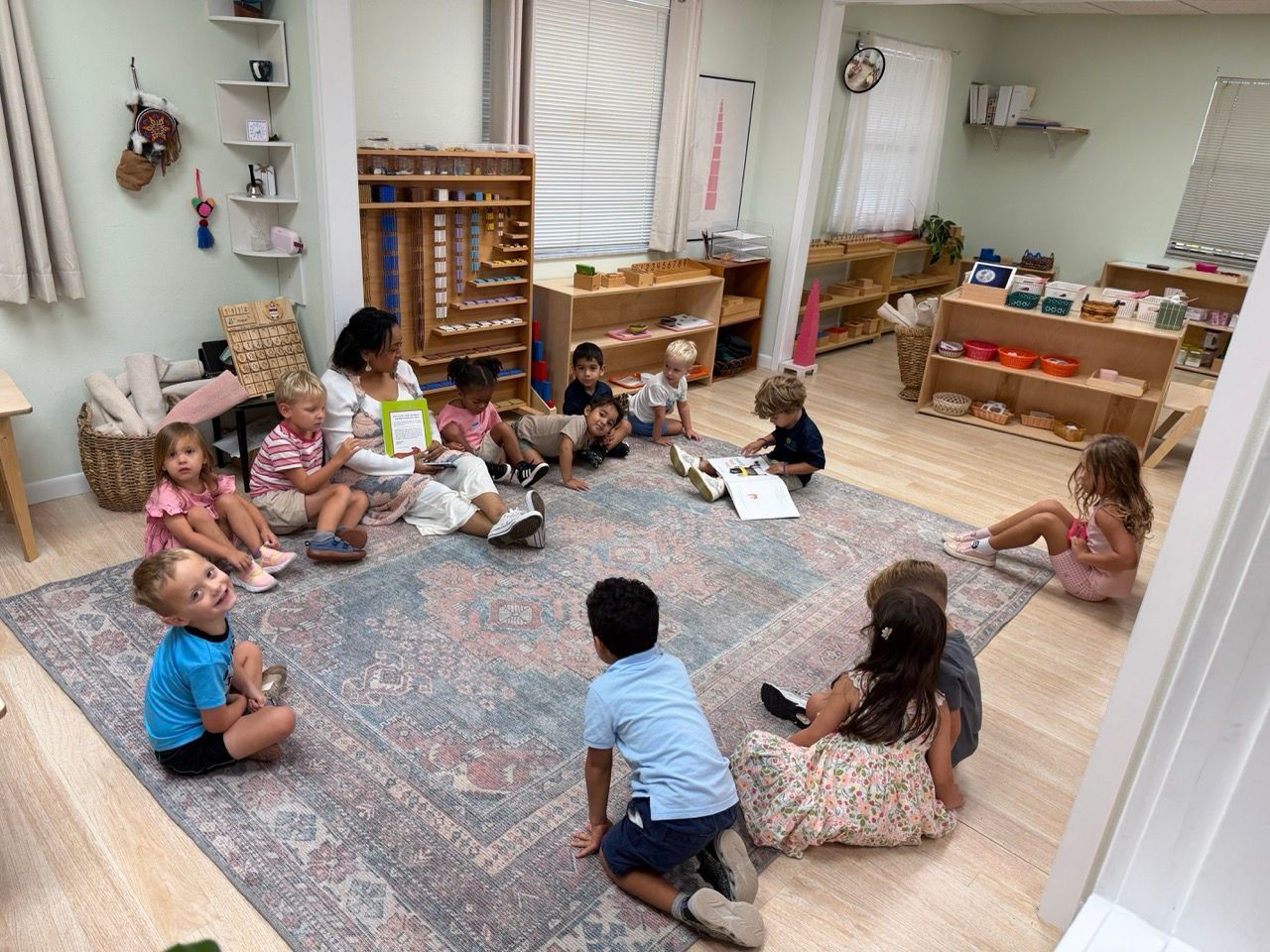

When you step into a classroom at Seeds of Life Montessori Academy, your eyes are immediately drawn to the warm, intentional design of the room. Perusing the environment, you will notice vibrant, colorful materials neatly arranged on the shelves, striking a purposeful contrast against the neutral, calming tones of our space.
These colorful learning materials are carefully chosen for their beauty to draw our children’s natural curiosity. However, aesthetics are only the beginning. At Seeds of Life, this color-coding serves as a fundamental framework for organization, self-regulation, and cognitive development.
Creating External and Internal Order
In our Nido, Primary, and Elementary environments, every detail supports the child's growing independence. In Practical Life, where children engage in purposeful work like scrubbing a table, cleaning a window, watering a plant, or arranging flowers, materials for each specific activity are color-coordinated. This intentional setup provides clear visual cues, allowing young children to independently access supplies (like finding the matching dry apron) and return them to their proper place.
Sensorial materials use color to isolate specific concepts, refining a child's perception:
- Isolating Variables: When discriminating dimensions with the Pink Tower, every cube is the exact same shade of pink so the child can focus solely on size.
- Pairing & Matching: Color-coding helps children self-correct and pair identical sets of materials, such as matching sound cylinders or color tablets.
By creating order in their external environment, children build a strong internal sense of order, focus, and security.
Integrated Across the Curriculum
As children progress into academic subjects (language, mathematics, and geography) this color framework becomes a continuous thread throughout their learning journey:
- Geography: Children begin exploring the world using our continent globes and puzzle maps. Each continent is represented by a distinct color: North America is orange, South America is pink, Europe is red, Asia is yellow, Africa is green, Oceania is brown, and Antarctica is white. Every supporting material, from image packets and extensions to research booklets, maintains this exact color scheme across all age levels.
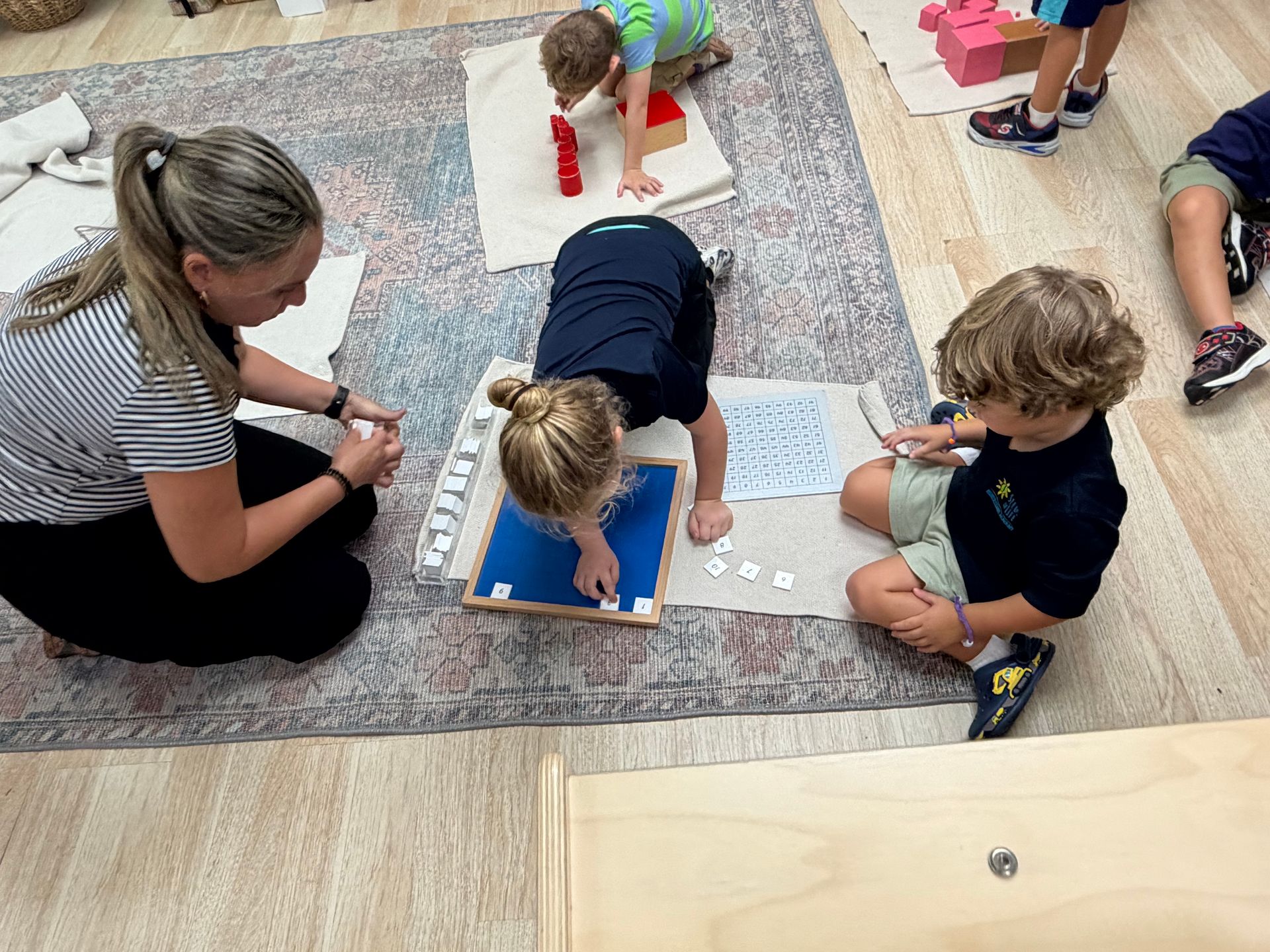
- Mathematics: Quantity is paired directly with color using our bead material. Every bead bar shares the same proportion, changing only in quantity and color:
- 1 - Red
- 2 - Green
- 3 - Pink
- 4 - Yellow
- 5 - Light Blue
- 6 - Light Purple
- 7 - White
- 8 - Brown
- 9 - Dark Blue
- 10 - Gold
- This consistency spans from early counting exercises in Primary all the way to advanced squaring, cubing, and algebraic concepts in Elementary.
- Language & Grammar: Place values follow a strict color hierarchy (units are green, tens are blue, hundreds are red), while parts of speech are represented by distinct color-coded geometric shapes (such as black equilateral triangles for nouns and red circles for verbs).
Strengthening Neural Pathways & Supporting Executive Function
While color-coding aids in physical organization, its true power lies in how it nurtures brain development, memory, and executive function. Modern research confirms what Dr. Maria Montessori observed over a century ago: color deeply influences attention, comprehension, and long-term retention.
Color helps build neural pathways that connect different forms of intelligence, enabling children to make deeper cognitive connections:
- Immediate Recall: When a child learns the quantity of six, they physically count the six light purple beads on the bar. Over time, the brain associates the light purple color directly with the quantity, allowing the child to recognize "six" instantly without recount.
- Deepening Abstraction: As students advance to complex operations—like compound multiplication or polynomial expansion—the established neural connection between quantity and color reduces cognitive load, allowing them to focus on higher-level problem-solving.
Guiding the Journey to Abstraction
Color-coding acts as a bridge, guiding children seamlessly from concrete, tangible materials to abstract thinking:
- Grammar Analysis: By pairing parts of speech with specific colors and shapes, children can visually parse complex sentence structures long before they memorize formal abstract grammar rules.
- Hierarchies of Number: Because place values maintain a repeating color pattern—units (green), tens (blue), hundreds (red), unit thousands (green), ten thousands (blue), hundred thousands (red)—children intuitively grasp the recurring structure of our base-ten decimal system.
- Moving Beyond the Concrete: When transitioning from physical bead cubes to abstract mathematical operations, children use small color-coded Stamp Game tiles. A green tile with a "1", a blue tile with a "10", or a red tile with a "100" carries complete concrete meaning because of the neural pathways built during earlier hands-on work.
A Powerful Aid to Learning
The intentional use of color throughout our Montessori environments is a powerful driver of cognitive growth, concentration, and confidence. Beyond aiding memory and mastery, it brings joy, beauty, and independence to every child's daily work.
We invite you to experience our vibrant learning environment in person!
Schedule a tour at Seeds of Life Montessori Academy today to see how our prepared environments bring learning to light.