If you visit our Casa classroom and watch a child slowly, carefully filling a traced shape with parallel lines, you might wonder: what is this for? It looks like coloring. It is something else entirely.
The material is called the Metal Insets, and it is one of the most purposeful objects in the Montessori prepared environment. Its purpose is not to produce artwork, though the results are often genuinely beautiful. Its purpose is to prepare the hand for writing. And the preparation it provides goes far deeper than most people realize.
What the Metal Insets are
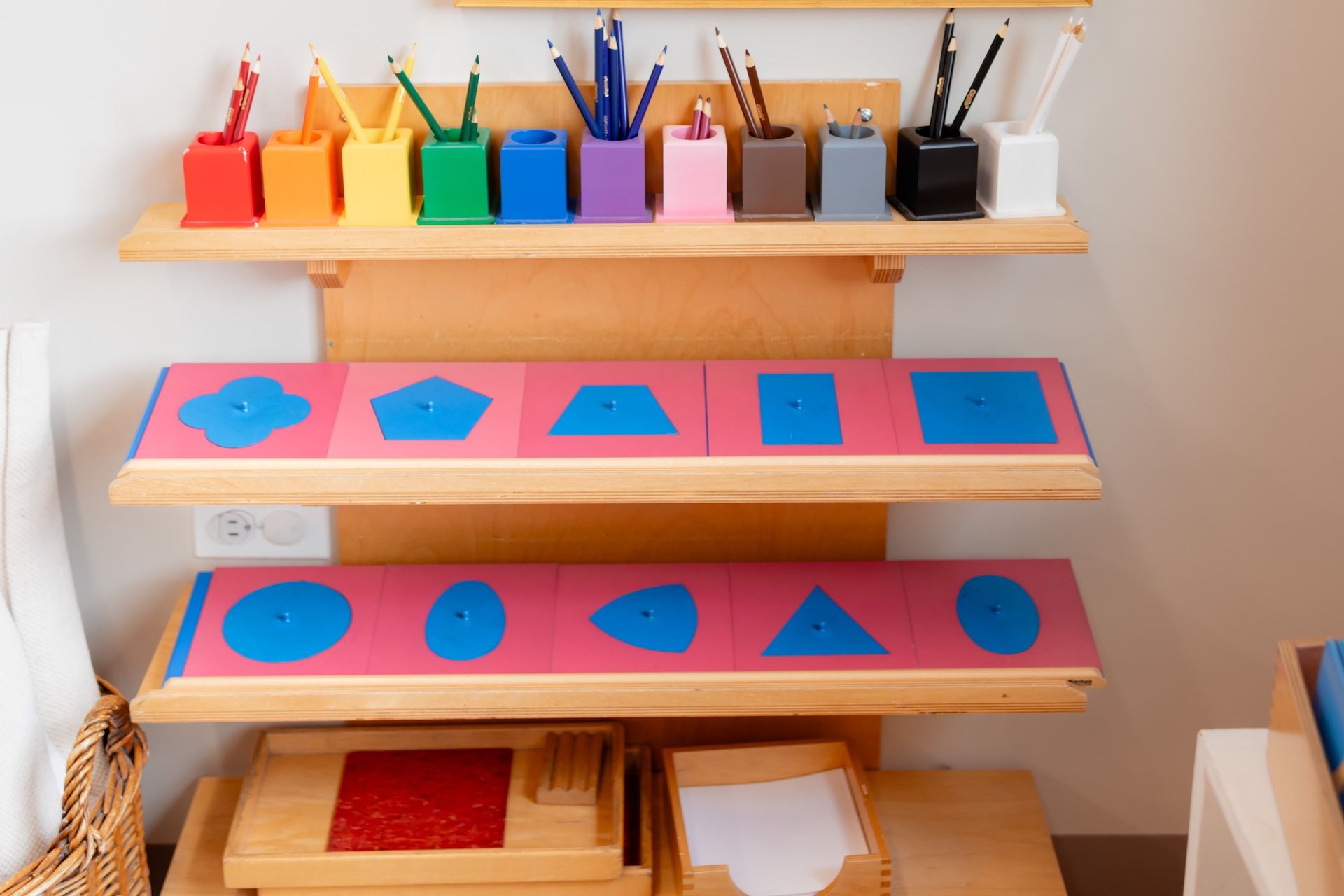
The material consists of two stands, each holding five metal frames and their corresponding insets ten shapes in total: square, triangle, circle, ellipse, rectangle, oval, trapezoid, pentagon, curvilinear triangle, and quatrefoil. The frames are red; the insets are blue, each with a small knob at the centre for holding. They are accompanied by paper, soft coloured pencils, and underlays that give a cushioned surface for pencil work.
The shapes are deliberately the same as those in the wooden geometry cabinet that children have already worked with in the sensorial area of the classroom. This connection is not accidental. By the time a child begins work with the Metal Insets, their hands already know these shapes. They have traced them, held them, sorted them. The Metal Insets build on what the body already understands.
What the child is actually doing
The basic exercise is this: the child places a frame on a piece of paper and traces its inside edge with one coloured pencil. They then place the inset inside the frame and trace its outside edge with a second colour. What remains is a shape defined by two outlines. The child then fills that shape with careful, parallel vertical lines from top to bottom, turning at each edge and continuing in the opposite direction back and forth, back and forth, working to close the distance between each line until there is almost no white space between them.
This filling work is extraordinarily specific in what it develops. The movement required to draw those parallel lines from the shoulder, not the wrist is precisely the movement used in writing. The child is not being asked to hold a pencil and copy letters. They are being asked to do something far more fundamental: to develop the muscular coordination, strength, and control that will later flow into letter formation as if it was always there.
We do not teach children to write at Seeds of Life. We build the hand that will write.
The four purposes and why they matter together
Our guides describe the Metal Insets as serving four purposes simultaneously, and it is worth understanding how they weave together:
• Mastery of the hand and the writing instrument keeping within the boundaries of the traced shape, developing lightness of touch, building control and precision
• Refinement of the hand for writing building the specific muscular strength and coordination that letter formation requires
• Development of a sense of geometric design working with geometric shapes, discovering their properties through movement
• Stimulation of the artistic sense the graded color exercise in particular, which asks the child to shade from dark to light by adjusting pencil pressure alone, produces results of genuine beauty when a child has the sensitivity and control to achieve it
These purposes do not compete with each other. They reinforce each other. A child developing their geometric sense is also developing their artistic sense. A child building hand strength is also developing the patience to work slowly and deliberately which is itself a form of preparation for all sustained intellectual work.
How the work develops over time
The Metal Insets are not a single exercise. They are a progression. A child begins with a single frame and inset, using three pencils one for the frame, one for the inset, one for filling. Over time, the work evolves: insets used alone without frames; multiple overlapping shapes; repeated tracings of a single shape in different positions, creating layered geometric designs; the graded color exercise; and finally, entirely free design using any combination of insets, colors, and orientations.
This progression can span a child's entire time in the Casa, from around three and a half to six years old. For many children, it becomes meditative a form of work that is simultaneously demanding and calming, requiring full attention while producing a state of deep quiet concentration.
And there is a community dimension too. When an older child works with the Metal Insets with great refinement lines close together, colors grading beautifully from dark to light, the younger children notice. They observe. They aspire. The material teaches across the age group, not only to the child holding the pencil.
When is a child ready?
Timing matters more than age. Two readinesses precede the Metal Insets: the child should be able to trace the geometric shapes and leaf shapes from the sensorial area using a stylus, and ideally should be working with the Movable Alphabet the Montessori material through which children begin to compose words and sentences before their hands are strong enough to write them conventionally.
Our guides observe each child carefully, looking for the moment when the Metal Insets will be received not as a challenge too great, but as exactly the right thing at exactly the right time. This is the quality of attention that a 1:7 guide-to-student ratio makes possible. A guide who knows seven children deeply can see a child's readiness in ways that would be invisible in a larger classroom.
What this looks like in our bilingual classroom
In SOL's Casa, the Metal Insets work happens in English and Spanish. The language of the conversation between guide and child naturally follows the child's dominant language, and both languages are present throughout the day. A child tracing a trapezoid in our classroom might hear both 'trapezoid' and 'trapecio' in the same morning, from the same guide. The shape is the same. The knowledge doubles.
The Metal Insets are one of dozens of carefully sequenced materials in our Children's House. If you'd like to see them in use and to understand, through a real classroom visit, why the Montessori prepared environment works the way it does, we'd love to have you come in.